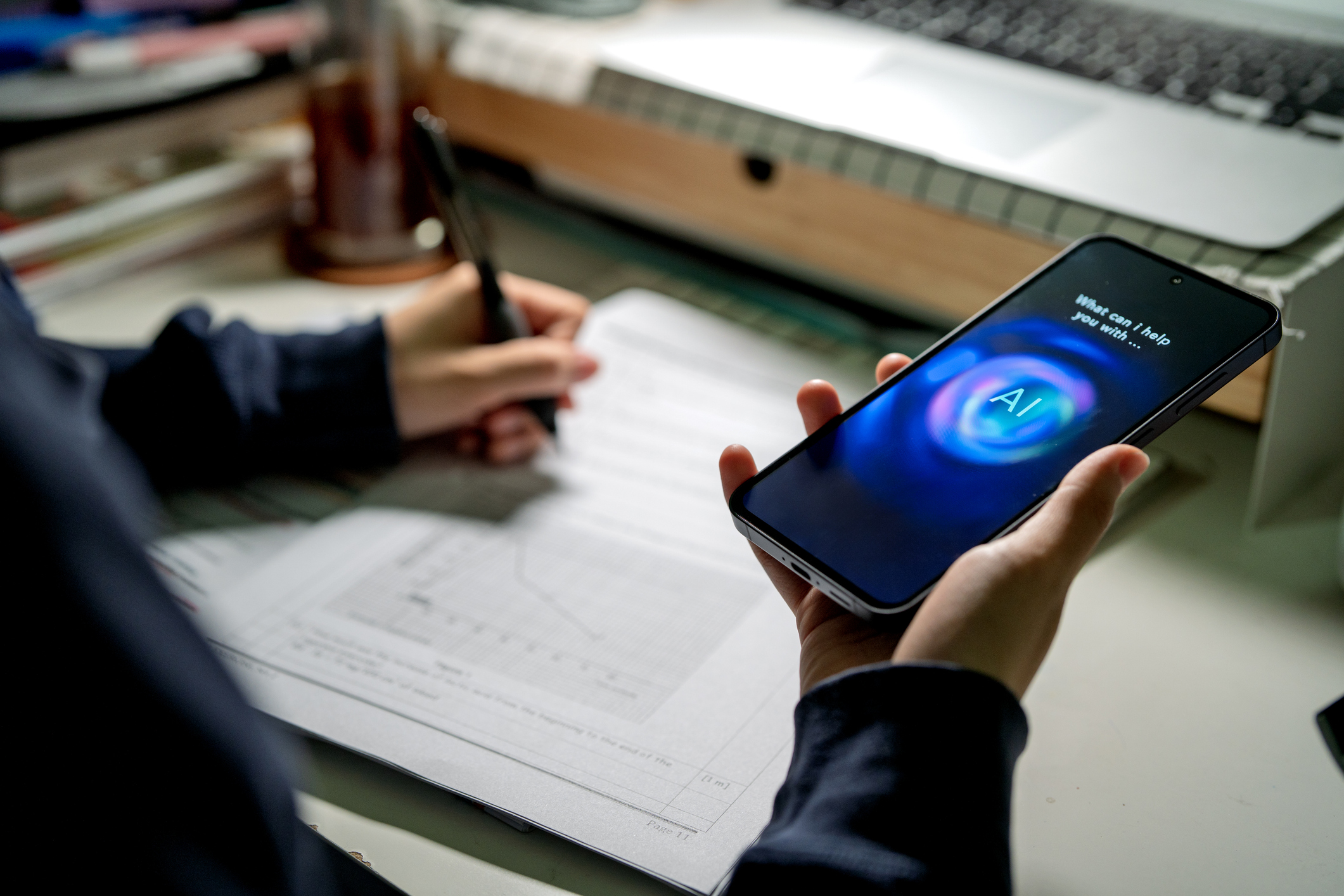
A student asks an AI chatbot to explain a tricky physics problem. The explanation is clear, the answer is correct, and the student closes the laptop feeling like they’ve got it. Two days later, on a test with no chatbot in the room, that same student draws a blank.
This is the AI Confidence Gap: the widening space between how prepared students feel after using artificial intelligence tools and how prepared they actually are. It’s quickly becoming one of the more prominent conversations in education, and for good reason. According to RAND’s American Youth Panel, the share of middle school, high school, and college students using AI for homework jumped from 48% to 62% between May and December of 2025. Separately, Fortune reported that 84% of students now use AI for homework, while only about three in ten schools have any formal policy governing AI in the classroom. Perhaps most telling: in RAND’s survey, 67% of students agree that AI use for schoolwork harms critical thinking, up from 54% earlier the same year. Despite the perception of harm to critical thinking, students are using AI to study anyway. It seems to work in the moment, even when it doesn’t work later.
How AI Manufactures False Confidence
AI tools are exceptionally good at making information feel understood. They break down concepts, generate clean answers, and remove the friction of not knowing something. That friction, though, is where real learning happens. Struggling to recall a formula, working through a wrong turn in an essay outline, or sitting with a confusing passage until it clicks: these moments build durable understanding. When AI smooths them over, students walk away with the feeling of comprehension without the retrieval practice that makes comprehension stick.
The result is a kind of borrowed confidence. Students’ overreliance on AI means they believe they know the material because they followed along with a correct explanation, or sometimes even an AI hallucination, not because they could produce that explanation, or solve a new version of the problem, on their own. That distinction rarely surfaces until it matters most: on a quiz, in a class discussion, or on test day.
How to Teach Critical Thinking When Every Student Has AI in Their Pocket
Educators can’t uninvent AI in the classroom, and most don’t want to. Used well, AI can be a genuine study aid: a tool for checking work, generating practice questions, or explaining a concept a different way after a student has already tried it themselves. For educators wondering how to teach critical thinking when a chatbot is one tab away, the shift is one of sequencing. Struggle first, then use AI to check or clarify, rather than asking AI first and treating the output as understanding.
A few habits reinforce this distinction in the classroom. Ask students to explain a concept in their own words before or after using an AI tool, and compare the two. Build in low-stakes retrieval practice, quizzes, flashcards, timed problem sets, so students generate answers instead of recognizing them. Frame AI as a tutor to argue with, not an oracle to copy. Each of these nudges students toward the only kind of confidence that holds up under pressure: confidence built from doing the work themselves or alongside a professional.
AI Doesn’t Know What a Test Will Ask
This is where the AI Confidence Gap collides directly with test prep. On exam day, there is no chatbot. No AI is sitting the SAT, the ACT, the GRE, or a state licensing exam for a student. Whatever a student can retrieve, reason through, and produce under timed, closed-book conditions is the only thing that counts. Test prep built on AI shortcuts doesn’t transfer to that environment because the exam measures exactly the skill that shortcuts skip: independent recall and application.
That gap between feeling ready and being ready is precisely why an honest, low-stakes way to check real readiness matters so much right now.
Practice Tests: The Honest Signal of Real Readiness
If studying solely with AI can inflate a student’s sense of preparedness, practice tests are corrective. A full-length, timed practice test strips away every crutch – no AI, no notes, no explanations on demand until after the fact – and shows a student exactly where they stand. It’s not a feeling. It’s a score, a set of missed questions, and a clear map of what still needs work.
Peterson’s Prep Advantage practice tests simulate real exam conditions so students get an accurate read on their actual readiness, not their AI-assisted readiness. Students who prepare with Peterson’s can trust that the readiness they see post-practice test is the readiness they’ll bring to test day.
In a landscape where AI can make almost anyone feel like an expert in five minutes, that kind of honest signal is worth more than ever. Educators steering students away from the AI Confidence Gap and toward real, testable understanding now have a natural partner in Peterson’s practice tests, built not just to make students feel ready, but to make sure they are before they enter test day.