
While the ASVAB covers many topics, online forums and study groups obsess over three specific ASVAB sections: The “Math Anxiety” of Arithmetic, the “I’m Not a Mechanic” fear of Mechanical Comprehension, and the “Brain Teaser” confusion of Assembling Objects. Many experience high anxiety over these ASVAB sections because they test skills many haven’t used since high school—or ever. If this is you, fret not! We aren’t just giving you ASVAB test questions in this blog; we are decoding the logic behind them so you can approach test day with strategy, not stress. To get a high score, you need exposure to realistic ASVAB practice questions in these specific categories. Let’s dive in!
ASVAB Arithmetic Reasoning: Transforming Anxiety into Structure
Why is ASVAB arithmetic reasoning so scary? It’s not just math; it’s translation. The challenge is turning a paragraph of English words into a simple math equation.
“How-to” Decode These Questions
- Step 1: Read the last sentence first (Identify the Goal).
- Step 2: Circle the numbers.
- Step 3: Choose your formula.
The Classic “Distance/Rate/Time” Challenge
Sample Question
Don and Frank started from the same point and drove in opposite directions. Don’s rate of travel was 50 miles per hour. Frank’s rate of travel was 40 miles per hour. How many miles apart were they at the end of 120 minutes?
- 90
- 10,800
- 140
- 180
Question breakdown
First, convert 120 minutes to hours so that we are working in the same time unit. There are 60 minutes in one hour, so you’d divide 120/60= 2 hours. Then plug what you know into the formula Distance = Rate × Time (𝑑=𝑟𝑡). Don drove 50 miles × 2 hours = 100 miles. Frank drove 40 miles × 2 hours = 80 miles. Since they went in opposite directions, add the two distances to learn that they were 180 miles apart. Therefore, the correct answer is D.
The “Secret Sauce” (Why You Might Get This Wrong)
The Trap: Students might pick ‘B’ because they forget to convert minutes to hours before multiplying. The ASVAB loves to mix units to test your attention to detail. Always match your time units and speed units first.
ASVAB Mechanical Comprehension: Physics for Non-Physics People
There’s a myth floating around that ASVAB mechanical comprehension is only for car mechanics. This is not true! This section tests “common sense physics”—how the world moves—not engine repair. Finding high-quality practice ASVAB questions for this section is key to visualizing the concepts.
Mechanical Comprehension “Pulley” Challenge
The Sample Question
Assume that a gear and pinion have a ratio of 3:1. If the gear is rotating at 300 revolutions per minute, the speed of the pinion in revolutions per minute is most nearly
- 100 rpm.
- 900 rpm.
- 300 rpm.
- 1800 rpm.
Question breakdown
Because of the ratio, the pinion will rotate 3 times for each rotation of the gear; 300 rotations of the gear will cause 300 × 3 = 900 rotations of the pinion. The correct answer is B.
The “Secret Sauce” (Why You Might Get This Wrong)
The Trap: It’s easy to rush and use intuition, assuming the larger gear moves faster than the pinion. It’s actually the opposite. Remember: Big gear = Strength; Small gear = Speed.
Assembling Objects ASVAB: The Visual Puzzle
Thought of as kind of a “wildcard”, the assembling objects ASVAB section generates curiosity because it feels to some like an IQ test. Pro tip: Don’t try to rotate the whole image in your head (it causes brain fatigue). Look for “unique connectors.”
The Assembling Objects subtest score is currently used only by the Navy and applies to very few occupations within this branch of the armed services. As of this blog post, no other branch of the military uses this score. You may check with your high school guidance counselor or your recruiter for possible changes.
The “Shape” Challenge
The Sample Question
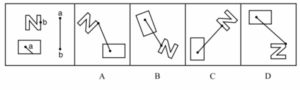
- Option A
- Option B
- Option C
- Option D
Question breakdown
- Identify a unique feature (e.g., “The tab with the black dot”).
- Find where that specific tab must connect in the final answer.
- Eliminate answers that don’t match that single connection.
The correct answer is C.
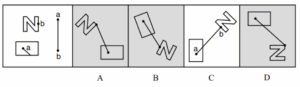
The “Secret Sauce” (Why You Might Get This Wrong):
The Trap: You might get this wrong if you look at the shape as a whole. Distractor answers often look correct overall but have a single line oriented the wrong way. Focus on the connections and where they are on the shape, not just the shape as a whole.
Beyond the “Big 3”
Mastering these three sections addresses many folks’ anxiety, confusion, and the test’s visual challenges. To find even more complex questions and understand all sections instead of just these three, take a full-length ASVAB practice test using our ASVAB Prep Course. You’ll find deep dives into every subtest, flashcards, and video lessons. Start your journey to a high score with even more sample ASVAB questions that prepare you for the real test.